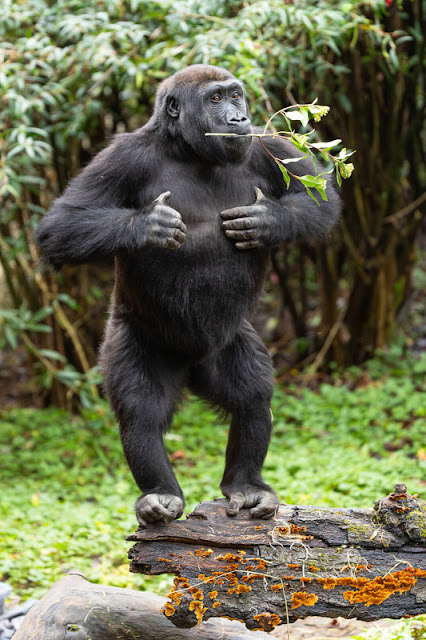
A 5.4-pound gorilla named Oku arrived in silence on May 24 at Woodland Park Zoo's animal hospital. He wasn't breathing. A team of human doctors from Providence Swedish First Hill worked to save him.
Twenty minutes later, NICU medical director Dr. Andrew Beckstrom felt tiny fingers wrap around his own. Oku had opened his eyes.
"That took maybe a year or two off our lives," Beckstrom said of the wait.
The emergency cesarean section on Oku's mother, a 30-year-old western lowland gorilla named Olympia, was the first gorilla C-section ever performed at the Seattle zoo. Fewer than a dozen have been recorded worldwide, according to Woodland Park Zoo, citing gorilla experts and the Gorilla Species Survival Plan. The surgery was first reported by the Seattle Times.
The surgical team was led by Dr. Emily Norland, chief of obstetrics and gynecology at Providence Swedish First Hill, and included maternal-fetal medicine specialist Dr. Suzanne Peterson, sonographer Nichole Hamilton and labor and delivery charge nurse Lily Pang, who has worked at Swedish for more than 30 years.
The Providence Swedish team had been monitoring Olympia and fellow gorilla Jamani since about 16 weeks into their pregnancies, conducting ultrasound scans every two weeks across their roughly 36-week terms. Zoo caretakers trained the gorillas to cooperate during appointments using positive reinforcement, primarily fruit.
On the day of the delivery, Norland noticed Olympia's amniotic fluid was absent on ultrasound, meaning her water had broken. Labor was not progressing, the baby had shifted lower in her pelvis and his heart rate had slowed. Norland said Olympia turned her back and glared during that final scan. The decision came quickly: it was time to intervene.
The surgery lasted about 90 minutes. Because gorillas are so active, Norland and Peterson stitched Olympia with more layers and bandages than a typical human patient would need.
Zoo caretakers painted Olympia's nails to distract her from pulling at the sutures when she woke.
Olympia received round-the-clock care her first night. By the following day she was back with her troop, climbing ropes within hours.
Two babies, one family
Six days before Oku's arrival, Jamani had delivered a healthy male named Kadre on May 18 in a natural birth lasting under 30 minutes. After the C-section, Jamani stepped in to care for both infants while Olympia recovered.
When Kadre began appearing lethargic and underweight, zoo staff made an unusual call: they swapped the babies. Jamani now raises Oku, and Olympia raises Kadre. Both mothers are nursing successfully.
Martin Ramirez, curator of mammalogy at Woodland Park Zoo, said the arrangement worked because Olympia is more inclined to bring a baby to protective mesh for supplemental bottle-feeding from keepers, making her a better match for Kadre's needs.
The two mothers have history. They first gave birth together in 2012 at the North Carolina Zoo, just weeks apart, and raised those sons side by side. They moved to Woodland Park together in 2022 along with Nadaya, the silverback father of both new babies.
A critically endangered species
Western lowland gorillas are classified as critically endangered by the IUCN, one step below extinct in the wild. Their population has declined more than 60 percent over the past 20 to 25 years due to hunting, the Ebola virus and habitat loss from logging. With the two new arrivals, Woodland Park Zoo now cares for 13 western lowland gorillas in two family groups. In all, 17 gorilla babies have been born at the Seattle zoo across its 120-year history.
Visitors hoping to see the babies can check zoo.org/animals/zoobabies for viewing updates, as the outdoor habitat may be intermittently closed to give the mothers space.
Separately, 6-year-old male gorilla Kitoko will leave the zoo as part of a natural bachelor-stage transition; Monday, Aug. 31, is the last day to see him.