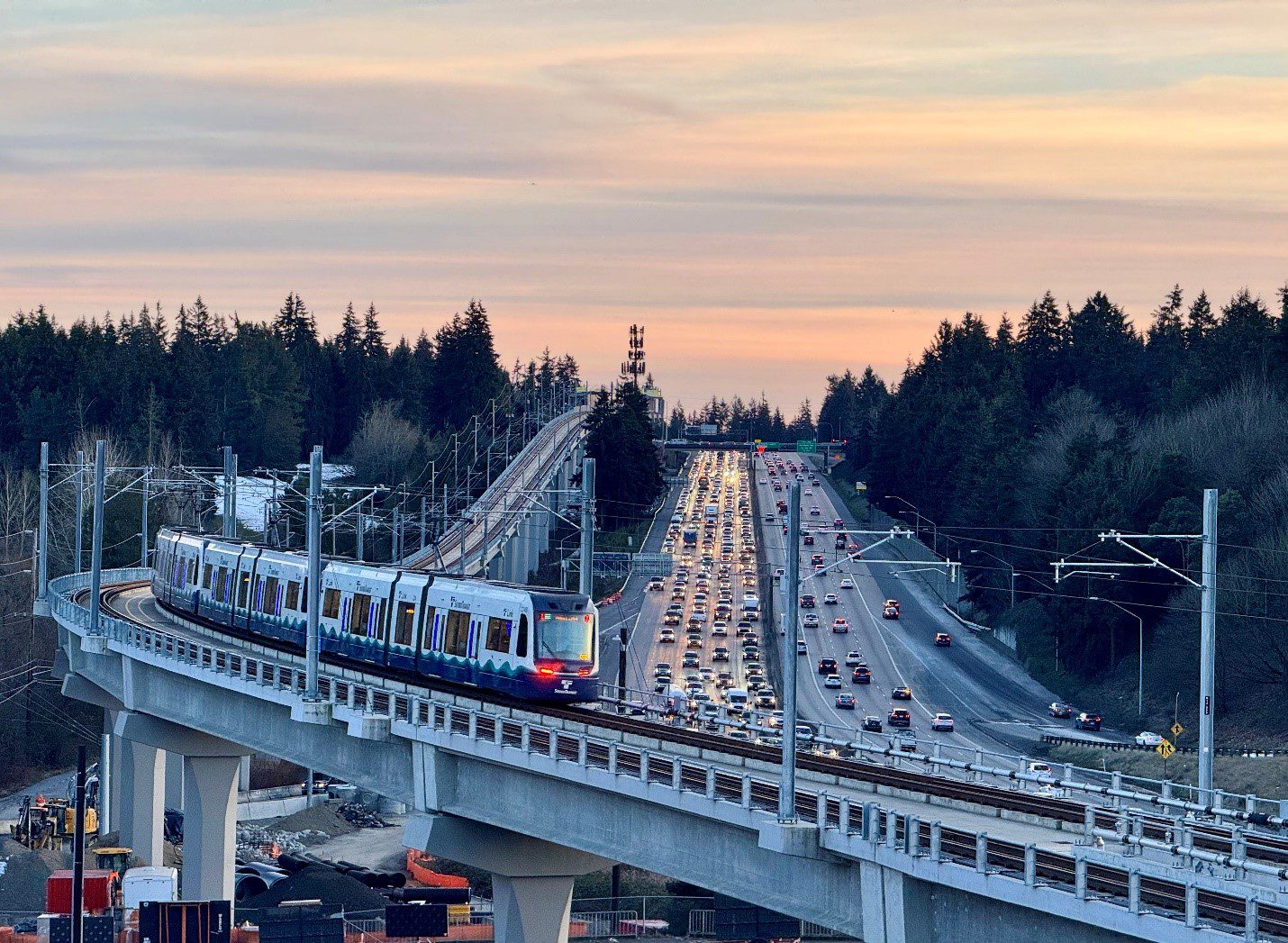
King County workers lose $10,381 a year in unpaid commute time, the steepest cost in Washington and the 40th highest among 2,192 U.S. counties.
The figure comes from a new analysis by Opus Virtual Offices, a virtual office services company, which reviewed U.S. Census Bureau American Community Survey data from 2020 through 2024. The study valued each county's average round-trip commute against local median full-time earnings over a working year. King County commuters spend 220.8 hours a year traveling to and from work, roughly nine full days.
Washington ranks fifth among the 50 states at $7,673 per year and 212.8 hours on the road, according to the analysis first reported by Seattle Red. Four Washington counties land inside the national top 100.
Other Puget Sound counties also rank high. Snohomish County is second in the state at $9,582 and 246.4 hours. Mason County follows at $9,576 and 288.8 hours.
Pierce County sits fourth at $8,528, and Kitsap County fifth at $8,077. Thurston County, home to the state capital, ranks sixth at $6,990.
The cheapest commute in Washington belongs to Walla Walla County at $3,555 and 120.8 hours, a gap of $6,827 from King County.
Yori Galel, CEO of Opus Virtual Offices, said the data reframes how workers think about the office. "Most people can tell you their salary to the dollar and have no idea what the journey to work costs them," Galel said.
The study lands in the middle of several live policy debates in Seattle. Sound Transit's board adopted an updated ST3 System Plan in May to address a projected $35 billion funding gap over the next 25 years.
The agency is pursuing 75-year federal TIFIA bonds after failing to secure the financing tool during the 2026 state legislative session, The Urbanist reported. The updated plan commits $18.1 billion to the Ballard corridor but defers three stations north of Seattle Center, pushing the full extension to Market Street to somewhere between 2042 and 2060.
For Ballard and Queen Anne commuters, the I-5 Ship Canal Bridge adds a more immediate cost. WSDOT's Revive I-5 project reduced northbound lanes on the bridge from Jan. 12 through June 5, paused, then resumed July 13 with two-lane reductions running through the end of 2026. Southbound work is scheduled for 2027.
Census Bureau data shows Seattle's average one-way commute fell 2 minutes and 30 seconds between 2019 and 2024, dropping to 25 minutes and 54 seconds, The Seattle Times reported. About one-quarter of the city's employed residents now work from home. Transit ridership dropped from 25% of Seattle commuters in 2019 to 15% in 2024.
Mayor Katie Wilson proposed in June to double the city's transit sales tax from 0.15% to 0.30% through a renewed Seattle Transit Measure. Wilson said June 2 that better transit could return "hundreds or thousands of dollars" to family budgets. The Seattle City Council must act to place the measure on the November ballot.
The Opus study's methodology carries a caveat: the company sells virtual office addresses, giving it a commercial interest in framing commuting as costly. The underlying Census data is public and authoritative. The $10,381 figure values time at local median earnings, not out-of-pocket expenses like gas or transit fares.
A separate study published in August found Seattle is the sixth-most expensive U.S. city to own a car, with average annual fuel costs of $2,912.88 and insurance costs of $2,199, according to MyNorthwest.
The Revive I-5 lane reductions resumed July 13 after a pause and continue through the end of 2026.