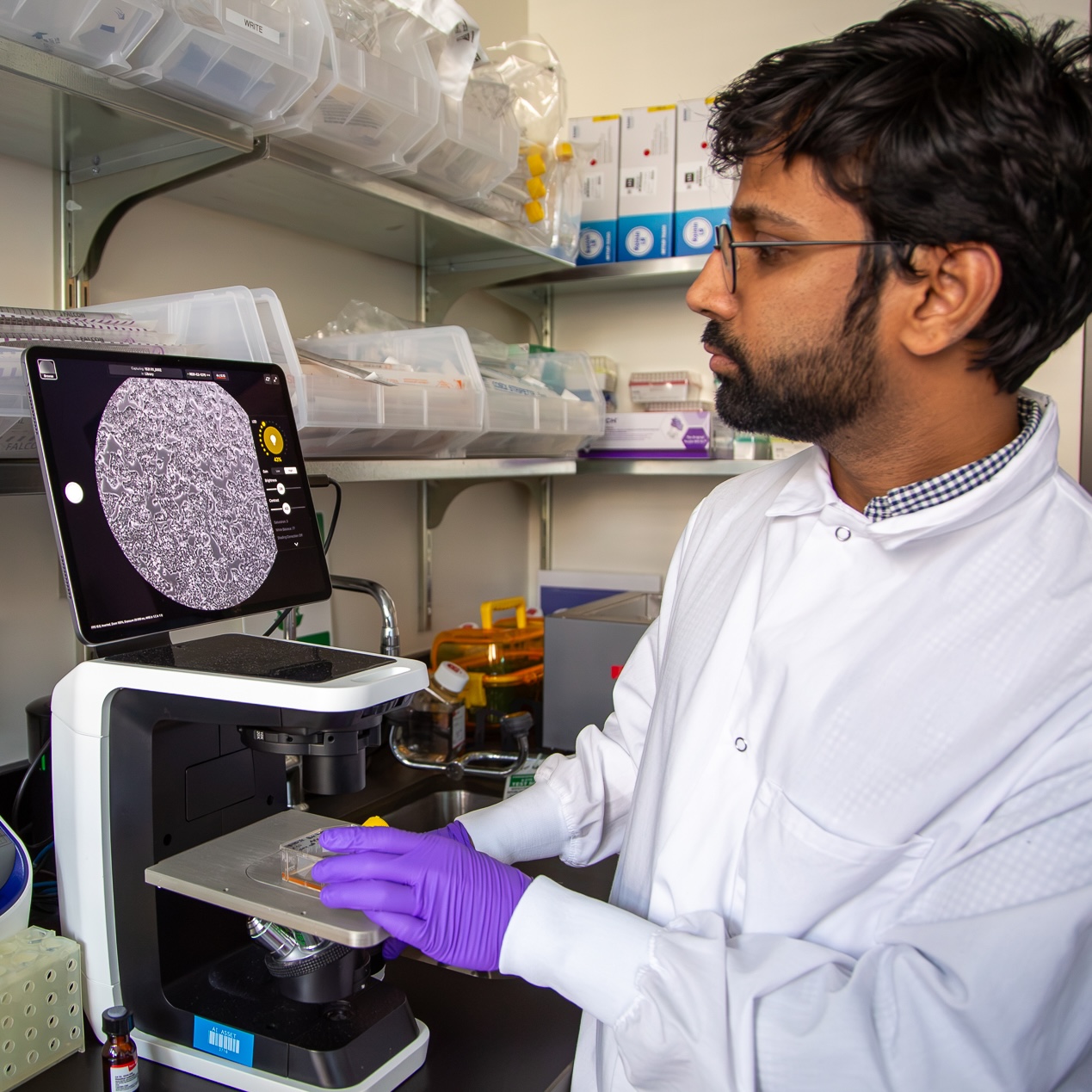
Sixty-two researchers are now working out of a Dexter Yard lab in South Lake Union, designing proteins that don't exist in nature. Their tool is artificial intelligence. Their budget is nearly $95 million.
AI BioDesign, a collaboration between the Allen Institute, the University of Washington and Fred Hutch Cancer Center, aims to engineer novel biological molecules for cancer therapies, RNA vaccines and infectious disease treatments. The Fund for Science and Technology (FFST), created from the estate of Microsoft co-founder Paul Allen, is providing $94.6 million over five years, as GeekWire first reported Sept. 3.
The funding breaks down to $46.1 million for the Allen Institute, $43.8 million for UW and $4.7 million for Fred Hutch.
As of mid-August, the 62 researchers split across the three institutions: 41 at UW, 13 at the Allen Institute and eight at Fred Hutch. The lab sits a short walk from the Allen Institute's headquarters, adding another anchor to the neighborhood's growing life-sciences cluster.
Nobel laureate David Baker leads the scientific effort. Baker, a UW biochemist who won the 2024 Nobel Prize in Chemistry for computer-designed proteins, also directs UW's Institute for Protein Design and has co-founded 21 biotech companies, many in Seattle, according to UW Medicine. Jay Shendure, a genome scientist at UW and the Allen Institute, co-leads alongside Baker. Sanjay Srivatsan, an assistant professor at Fred Hutch, serves as scientific co-director at the Allen Institute.
"Any therapies like vaccines, cell therapies, immunotherapies, things that can affect the course of cancer, infectious disease — these are all within the purview of AI BioDesign," Srivatsan said in a KING 5 interview Friday, Sept. 25.
The initiative's scale depends on a DNA sequencer that reads millions of sequences from a single tube at once. One recent experiment ran 6 million distinct sequences in a single run. Jesse Gray, executive director of strategy and platform for AI BioDesign and a former Harvard Medical School geneticist, told GeekWire the scale "comes not from robotics, but from parallelizing inside the test tube."
All results will be shared freely. That open-science commitment covers every data set and trained AI model the initiative produces, according to the Allen Institute. Allen Institute President and CEO Rui Costa said the initiative needs to show real progress within 18 to 24 months and expand to researchers worldwide within five years. Costa said the open approach reflects Paul Allen's goal of accelerating the field rather than competing within it.
Based on Costa's stated 18-to-24-month window, the first major progress check would fall around early to mid-2028.