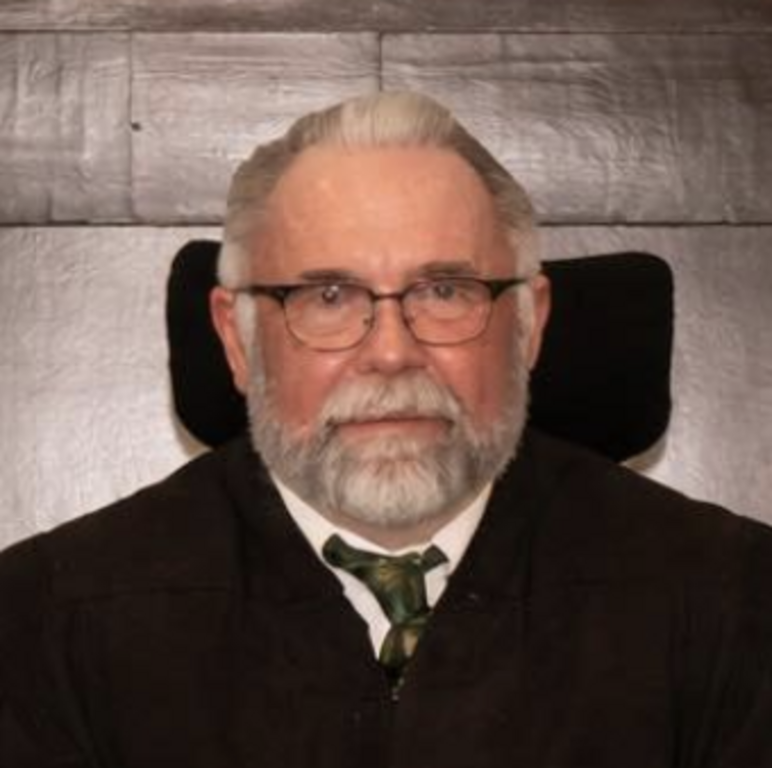
Seattle voters will find Washington State Supreme Court Justice Position 3 on their Nov. 3 ballots. Mason County Superior Court Judge David Stevens finished first in the Aug. 4 primary with 612,267 votes, or 35.2% of the vote, out of three candidates. He now advances to the general election.
Stevens said he is running because "Washington deserves Supreme Court justices who are experienced, independent, and constitutionally grounded." He described the current court's majority as "activist judges" appointed by the governor and said the court "should not replace the role of voters or the Legislature." His positions on the capital gains tax ruling, public defense and criminal justice carry direct implications for Seattle residents.
Candidate information
Residence: Shelton, Mason County
Education: Bachelor of Arts, University of Washington, 1991; Juris Doctor, University of Washington School of Law, 1999; Certificate in Islamic Jurisprudence, U.S. Department of State
Family: Married to Pamela for 31 years. Five children and ten grandchildren.
Party affiliation: Stevens listed his party affiliation as "Not applicable." The race is nonpartisan. He has received endorsements from the Washington State Republican Party, the King County Republican Party, the Snohomish County Republican Party, the Spokane County GOP and the Kitsap County GOP.
Community involvement: Deacon at Mount Olive Lutheran Church in Shelton, member of VFW Larry Godwin Post 1694 Honor Guard, Skookum Rotary member, University of Washington Law School mentor, YMCA and UW Law School mock trial judge.
Experience and public service
Stevens served in the U.S. Navy as a Fire Controlman Second Class aboard the USS Camden AOE-2 in Bremerton and received an honorable discharge.
After earning his law degree, Stevens held a range of legal positions. He served as chief public defender for the Colville Confederated Tribes, a criminal defense attorney in private practice, chief criminal deputy at the Okanogan County Prosecutor's Office and senior deputy prosecutor at the Mason County Prosecutor's Office. He also worked as a Special Assistant U.S. Attorney in the Eastern District of California, an international prosecutor in Prishtina, Kosovo, and a justice advisor in Bamiyan, Afghanistan.
Before law school, Stevens worked as a federal civil rights investigator at the U.S. Department of Housing and Urban Development's Fair Housing Enforcement Center in Seattle.
Stevens was elected to Mason County Superior Court in 2023, defeating an incumbent who had been appointed by then-Gov. Jay Inslee. He was re-elected in 2024.
On the issues
Judicial philosophy: Stevens describes himself as a textualist in statutory interpretation and an originalist in constitutional interpretation. He said he "strongly favor[s] judicial restraint and stare decisis" and rejects purposivism, which he defined as interpreting statutory language through a perceived legislative purpose. He said courts should not substitute their judgment for legislation or initiatives simply because judges believe a different result would make better policy.
Stevens said constitutional change should come through amendment, not judicial reinterpretation. He stated he is "strongly opposed" to what he called the "Legal Pragmatism approach (the living-Constitution approach)" favored by his opponent.
Role of the courts: Stevens said public policy belongs to the political branches and the people, not the courts. He cited the state capital gains tax ruling and decisions on public defense and juvenile warrants as examples he views as policymaking from the bench, telling KUOW: "They're doing things that make the system worse."
Criminal justice: Stevens opposes race-based evaluation of jury selection, stating it forces courts "to treat jurors differently based on their race," according to KUOW. He also supports judicial authority to issue warrants for defendants who fail to appear.
Trial experience: Stevens said the Supreme Court should have justices with trial experience. He said he conducted more than 200 criminal jury trials to verdict before becoming a judge, earning the nickname "No Deal Dave" as a prosecutor.
The general election is Nov. 3.
Washington conducts elections entirely by mail.