Seattle's City Attorney's Office has a backlog of 1,700 domestic violence, child abuse and elder abuse cases waiting for review.
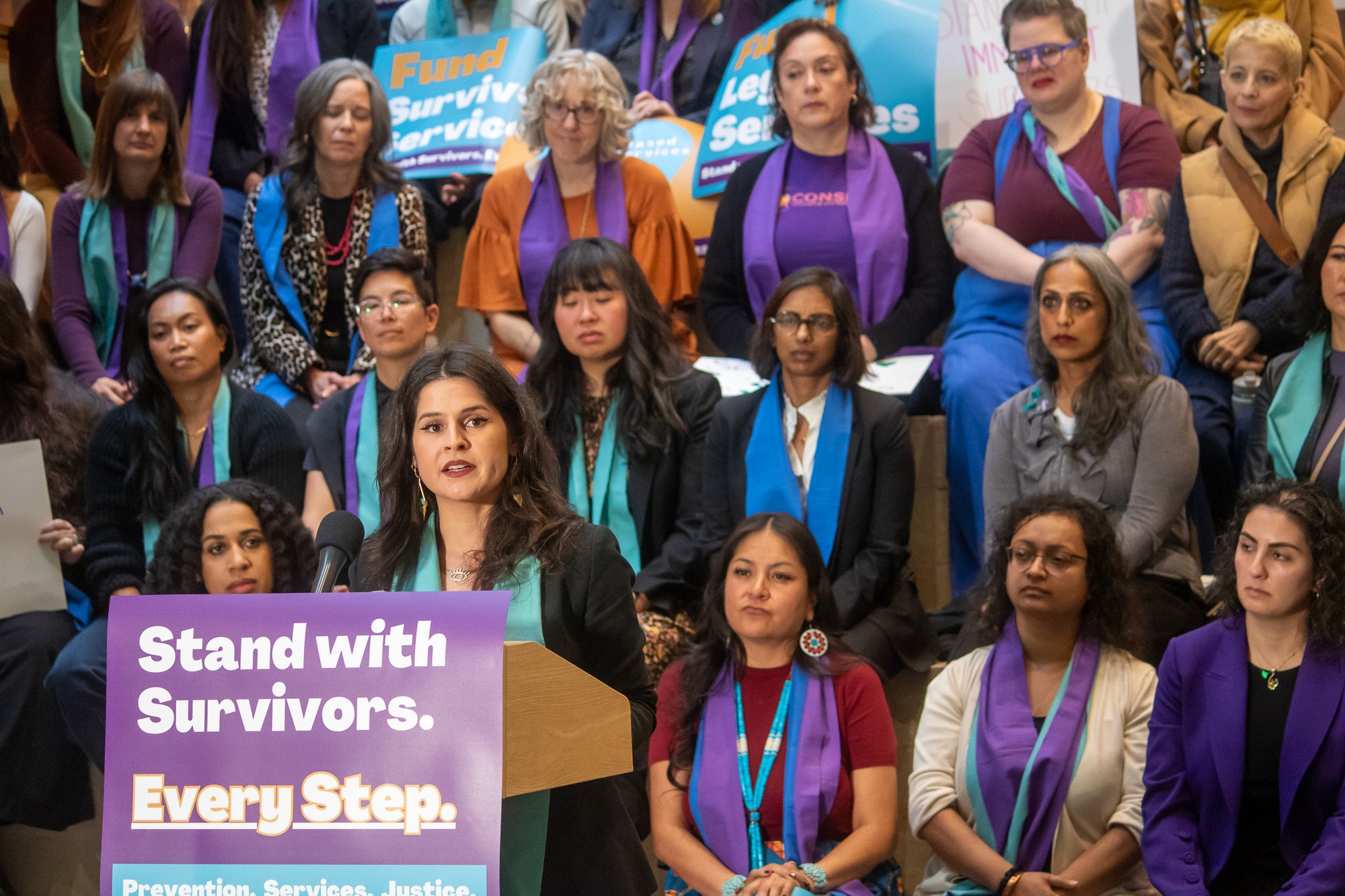
Councilmember Alexis Mercedes Rinck wants $8 million added to the city's 2027-2028 budget to stabilize survivor services that she and a coalition of organizations say are buckling under federal funding cuts. Rinck announced the "Seattle Stands with Survivors, Every Step" campaign Wednesday, Oct. 14, at City Hall alongside more than a dozen service organizations, medical institutions and elected officials.
The money would fund direct survivor supports including legal advocacy for victims of domestic violence, sexual assault, human trafficking and child abuse. Rinck is also introducing a Statement of Legislative Intent (SLI) requiring city departments to report progress on gender-based violence to the Human Services, Labor and Economic Development Committee.
The proposal lands during a tight budget year. Mayor Katie Wilson's proposed $9.1 billion two-year spending plan, according to KOMO News, closes a projected $175 million general-fund deficit in 2027 through spending cuts and no new taxes. The Urbanist reported that Wilson's plan includes a 50% cut to the Collective Network Grant Program, which funds community-led domestic violence response outside the criminal legal system.
The coalition points to a steep drop in federal support. Across Washington, federal Victims of Crime Act (VOCA) funding fell from $74.7 million in 2018 to $17.8 million in 2024, according to the council's announcement. The state has backfilled with temporary appropriations each year, but organizations say the unpredictability has left them unable to plan.
Local programs are already feeling the squeeze. The Safe, Healthy, Empowered Clinic at Aurora Commons lost $345,000 in state and federal funding, reducing its capacity and service hours. New Beginnings, which provides survivor-specific emergency housing, anticipates up to a 75% cut in federal funding for its Community Advocacy Program due to changes in the U.S. Department of Housing and Urban Development's Continuum of Care program.
City Attorney Erika Evans, who joined the announcement, said the case backlog predates her tenure. "Upon taking office, I was shocked to learn that I had inherited a backlog of 1,700 police reports involving domestic violence, child abuse, and elder abuse … a backlog that's sustained over multiple administrations cannot be solved without additional prosecutorial resources," Evans said in a statement released by the council.
Councilmember Dionne Foster said she is proposing one-time resources in the 2027 budget to accelerate case reviews in the City Attorney's Domestic Violence Unit. The amendment details have not been released.
Nearly one-third of all cases referred to the City Attorney's Office from the Seattle Police Department involve domestic violence, according to the council's announcement. Thirty-three percent of the office's criminal case backlog involves domestic violence, elder abuse, sexual assault or stalking.
The council approved $16.6 million for gender-based violence services in the 2026 budget, including $500,000 for the King County Sexual Assault Resource Center. The new $8 million proposal would add to that baseline.
Rinck plans to submit her budget amendment before formal briefings begin Oct. 27. A public hearing is scheduled for Nov. 5, and the council is set to take its final budget vote on Friday, Nov. 20.