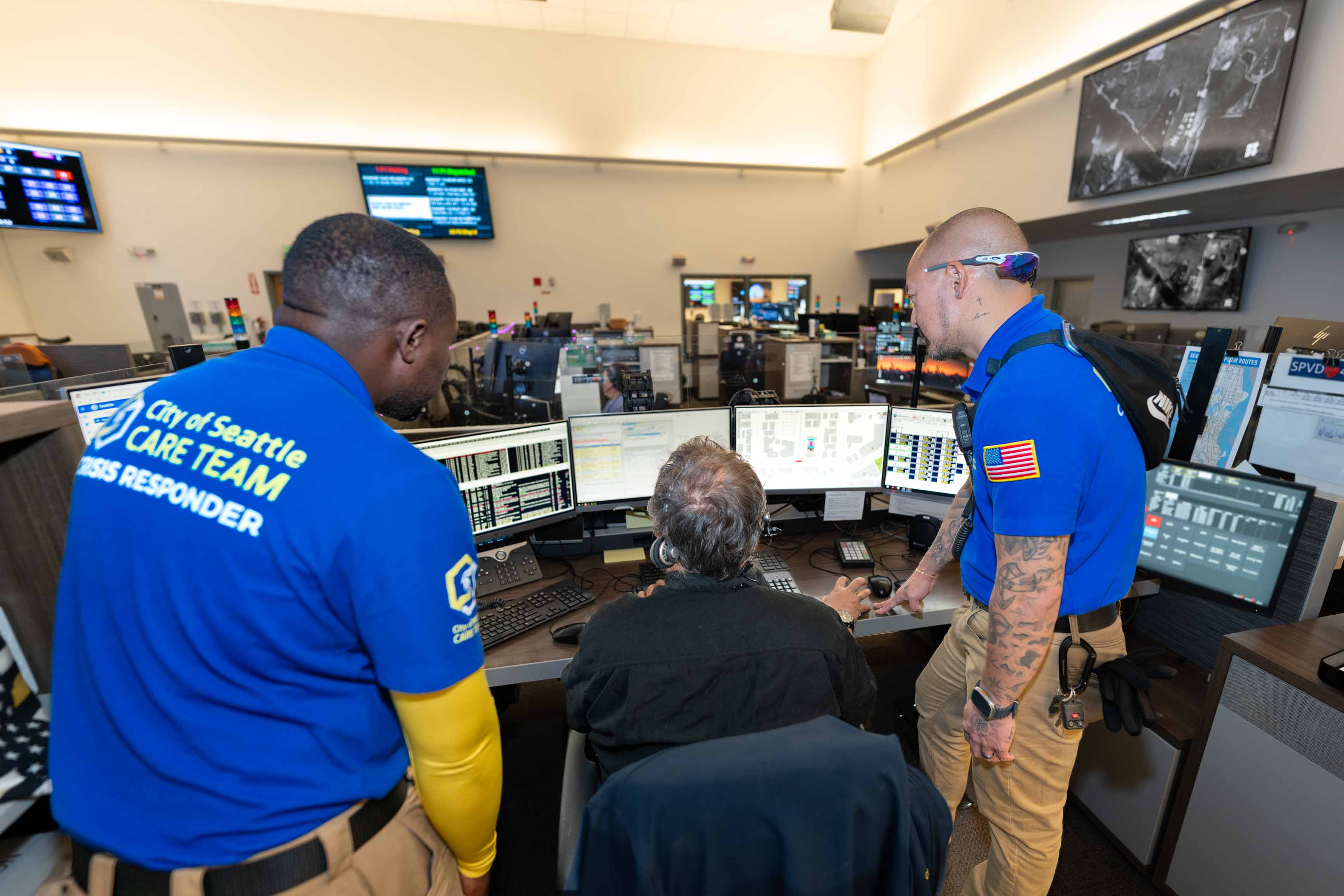
Starting Wednesday, Aug. 5, a Queen Anne resident who calls 911 at 7 a.m. about a neighbor in mental health crisis can get an unarmed counselor instead of a patrol officer.
Seattle's CARE Department is expanding its Community Crisis Responder hours from the current noon-to-10 p.m. window to 6:30 a.m. to 1 a.m. daily, citywide. The change nearly doubles the program's availability to 18.5 hours a day and covers the time slots when demand is highest: city call data shows 84% of the CCR program's most common call types — welfare checks, resource requests and crisis assistance — come in during that broader window, according to the department's announcement.
Demand is climbing fast. Crisis responders have already handled 6,279 calls so far in 2026, closing in on the 7,136 total for all of 2025.
How to request a crisis responder
Residents in Ballard, Queen Anne, Magnolia and across Seattle can request a CCR team two ways:
- Call 911 and ask for a mental health crisis response.
- Call the non-emergency line at 206-625-5011 for welfare checks, referrals or resource requests.
Call-takers evaluate the situation and route the response. CCRs are unarmed mental health professionals trained for non-violent behavioral health situations.
What the responders can and can't do
The expanded hours don't remove existing dispatch restrictions. Under the current Seattle Police Officers Guild contract, CCRs can only respond in public outdoor spaces.
They cannot enter buildings, vehicles or private property, and cannot be dispatched when minors are present, drug paraphernalia is visible, confrontational behavior is occurring or a potential crime is involved, Capitol Hill Seattle Blog reported. SPD's 911 routing policies also block CARE from about half of "dual-dispatch" scenarios, according to earlier CHS reporting.
So a 7 a.m. welfare check on someone sitting in distress at a bus stop on 15th Ave. NW? A crisis responder can take that. A call about someone in crisis inside an apartment? Still goes to police.
The money behind the expansion
The city funded the growth with $6.9 million in the 2026 budget to double CCR staffing, adding 24 new responders and six supervisors, plus vehicles and equipment. That money comes from Seattle's 0.1% Public Safety Sales Tax, which generates roughly $39 million annually; $15 million goes to CARE operations.
CARE Chief Amy Barden leads the department, which as of June was on track to reach 48 responders and nine supervisors.
The bigger picture
Mayor Katie Wilson addressed the program's constraints in a July 9 interview with PubliCola, saying: "There's plenty of people in crisis, so it's really a matter of how do we get the CARE team to a place where they're serving people in crisis. And I think there's a lot of opportunities to do that."
The CARE Department began as a $1.5 million pilot. A 2026 ordinance codified its boundaries, explicitly barring CCRs from criminal law enforcement or issuing citations.
The 1 a.m.-to-6:30 a.m. gap remains. During those five and a half hours, police are still the only option for crisis calls.