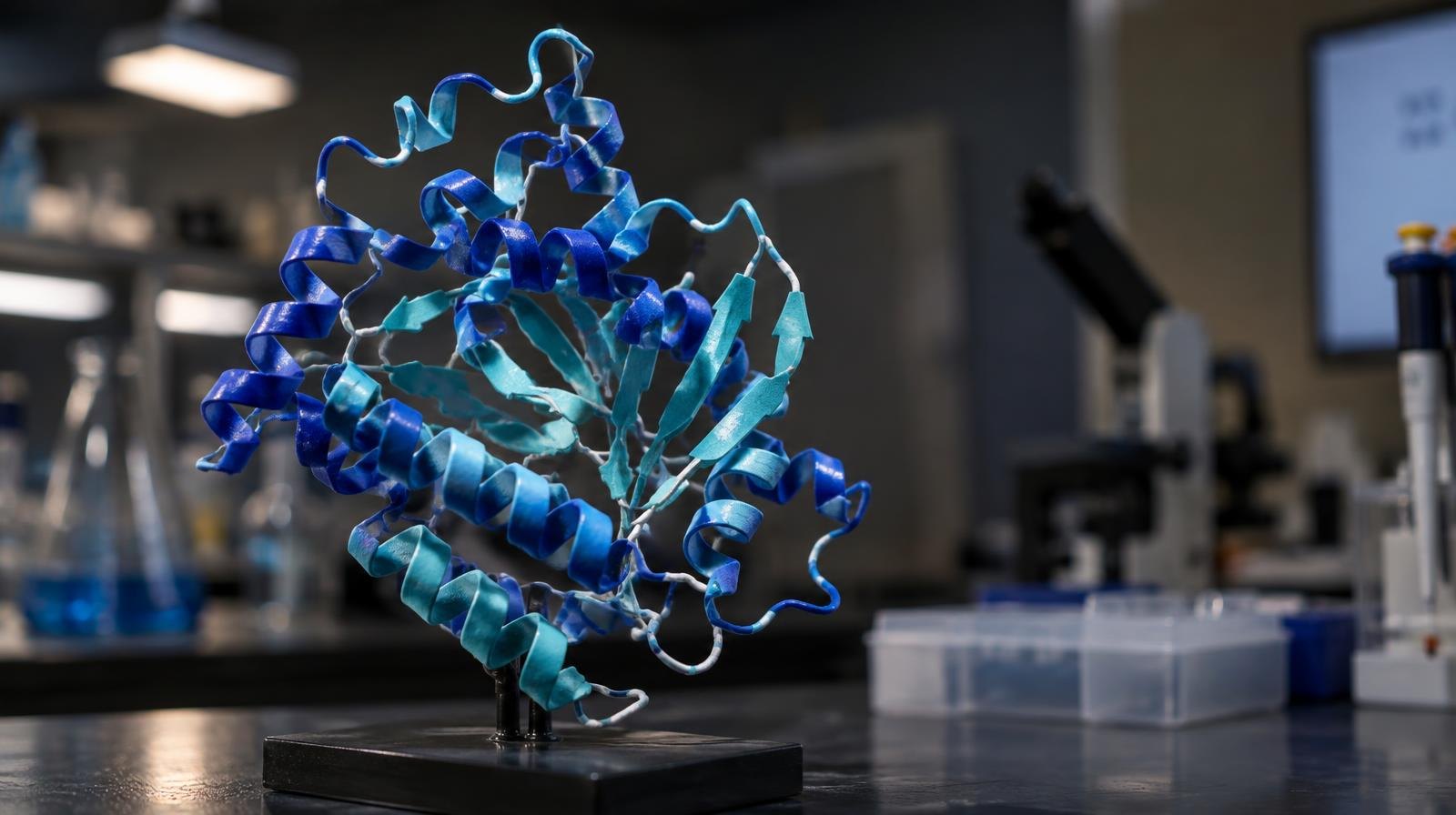
The University of Washington's Institute for Protein Design (IPD) released an open-source AI model on Wednesday, Oct. 21, that designs proteins up to 10 times faster than previous tools. It is the first AI protein model the university has co-developed with chipmaker Nvidia, as first reported by GeekWire.
The model, called RFD4-Proteina, achieves fivefold to tenfold higher design success rates and generates protein candidates five to 10 times faster, according to a UW Medicine news release. Lab tests confirmed the results.
One UW researcher saw the difference immediately. Seth Woodbury, a bioengineering predoctoral candidate and National Science Foundation fellow, said he had spent months designing a pesticide-degrading enzyme using older tools. "In just a few days we designed a pesticide-degrading enzyme that performs many fold better than my previous best, which took months to design," Woodbury said.
IPD director David Baker, a 2024 Nobel laureate in chemistry, said in a statement that the model "will open the door to new solutions in medicine, sustainability, materials and biotechnology." Baker told GeekWire earlier this month that the computing grant behind the work has been "transformational."
That grant came from the Jen-Hsun and Lori Huang Foundation, co-founded by Nvidia CEO Jensen Huang and his wife. The foundation provided nearly 7 million GPU hours through cloud company CoreWeave, according to a separate UW Medicine announcement. IPD began accessing the computing power in June, and the allocation is expected to last a year.
Before the grant, IPD scientists relied on a limited in-house computer cluster. Baker told GeekWire that researchers met every Tuesday at 5 p.m. to decide what to test each week, keeping capacity in mind. The new resources let them test changes individually rather than bundling multiple experiments at once.
RFD4-Proteina merges two lines of computational models: IPD's RosettaFold Diffusion tools and Nvidia's Proteina-Complexa. The model uses what UW Medicine called "biomolecular reasoning," devoting more computation to difficult problems and refining a protein's sequence and structure alongside interacting molecules simultaneously.
Potential applications include drug candidates for diseases and enzymes that break down toxic chemicals and plastics. IPD lists 11 spinout companies, including vaccine developer Icosavax and protein-design startup Archon Biosciences.
UW doctoral students Nathaniel Corley, Maxwell Kazman and Rafi Brent led the project at IPD, along with Kieran Didi, a visiting student from the University of Oxford. The model is available as open-source software through the Berkeley Software Distribution license.
Nvidia announced the release at its GTC Berlin conference on Oct. 21. The model is also available through Nvidia partners including Amazon Bio Discovery, Google Cloud, Microsoft Azure and Hugging Face, according to MobiHealthNews.