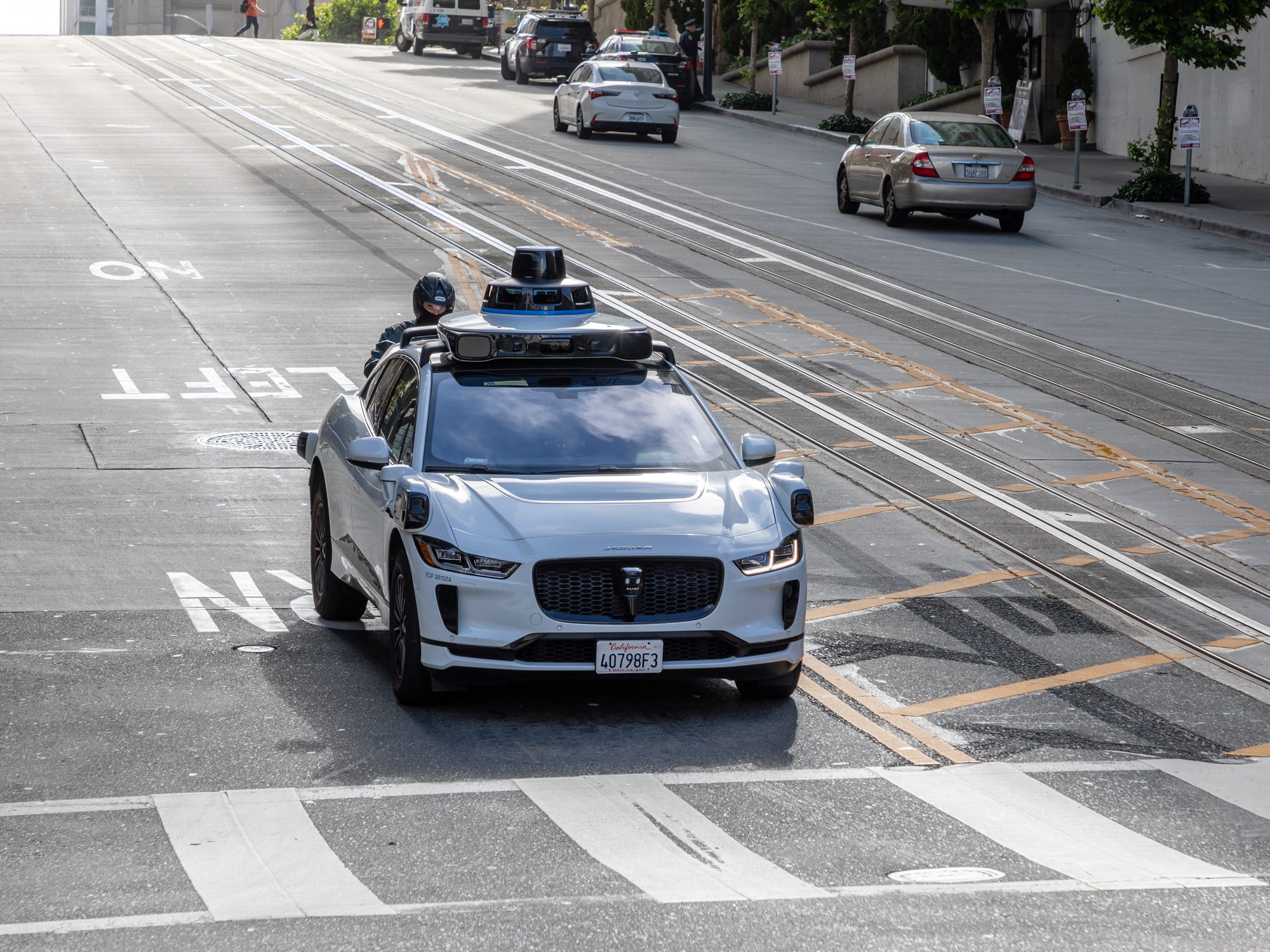
Waymo vehicles are collecting street-level data across Seattle and the Eastside, raising questions about how the company stores recordings and responds to requests for footage. Seattle identifies Waymo’s current operations as manual data collection, with human drivers controlling the vehicles.
That gap matters now. On Nov. 10, Mayor Katie Wilson announced she would expand the Seattle Police Department's surveillance camera network into Capitol Hill and the Central District, triggering a fresh round of debate over government recording in public spaces. But a parallel source of street-level recording has drawn far less scrutiny: the growing fleet of Waymo test cars moving through neighborhoods like Ballard, where GeekWire spotted a new baby-blue Ojai model in a Fred Meyer parking lot in August.
Each Ojai carries 13 exterior cameras and four lidar sensors, according to the San Francisco Examiner figures cited by GeekWire. The cameras work in daylight and low-light conditions with a 360-degree field of view, according to Waymo's own camera policy page. Interior cameras record video during every trip.
What Waymo collects on public streets
Waymo’s privacy policy, updated Oct. 19, describes collecting information through vehicle cameras and sensors. Its separate Europe-specific section explicitly discusses capturing bystanders’ faces and vehicle license plates, but that section should not be treated as a statement of Seattle residents’ legal rights.
The company says it does not use facial recognition or other biometric identification technologies. In an August blog post, Waymo said its cameras collect data for "core functions like mapping routes, delivering our services safely, and improving our technology" and that it does not sell personal information collected by vehicle sensors.
But the privacy policy also permits Waymo to share personal information to "comply with any applicable law, regulation, legal process, or governmental request" and to "protect the rights, property, or safety of Waymo, our customers, or others."
Law enforcement access
On multiple occasions, law enforcement agencies have obtained search warrants for footage captured by Waymo vehicles, The Verge reported, citing Bloomberg. The LAPD obtained footage of a hit-and-run recorded by a nearby Waymo, according to The Verge's account.
Waymo does not publicly disclose how many law enforcement requests it receives or how often it complies, The Verge reported.
In one San Francisco incident, Waymo's automated system detected what it identified as a firearm inside a vehicle and initiated a police response, according to The Verge. Waymo spokesperson Julia Ilina told The Verge the company uses "automated technology to help Waymo's teams identify potential violations" and that "if Waymo detects a firearm in the vehicle, we may reach out to local law enforcement."
Hayley Tsukayama, director of state affairs at the Electronic Frontier Foundation, told The Verge that Waymo's public policies are "very broad" and that the company should clearly disclose the possibility of a police response before passengers board.
Testing rules and privacy questions
Seattle requires a Street Use permit for autonomous-vehicle testing and requires a human driver aboard who can take control. SDOT currently lists Waymo’s vehicles as manually driven for data collection, with the automated driving system inactive. That activity does not require the city’s autonomous-vehicle testing permit.
Washington also has a self-certification program for autonomous-vehicle testing, including insurance, reporting and advance notification requirements. Waymo is listed among the self-certified companies.
Sen. Matt Boehnke introduced SB 6243 in January to address autonomous-vehicle operations. The bill was referred to the Senate Transportation Committee and did not advance, according to its legislative history.
The police camera contrast
Wilson paused the police camera expansion in March and announced its resumption Nov. 10 following an NYU Policing Project audit. The audit says city ordinances require a 60-day pause in CCTV data collection if Seattle must release footage for use in civil immigration enforcement or a reproductive or gender-affirming health care matter.
SPD's Real Time Crime Center employs 29 civilians who log into the Axon system with unique employee numbers, and the city owns the video data, police spokesperson Patrick Michaud told Westside Seattle.
Seattle’s announced safeguards govern the police department’s surveillance program. Waymo’s vehicle recordings are maintained separately under the company’s policies and applicable law.
People with privacy concerns can contact Waymo through its privacy-request page or call 1-844-261-3753. The page says responses may take up to 30 days, with additional time in some cases. Requests may be limited by legal or security requirements.