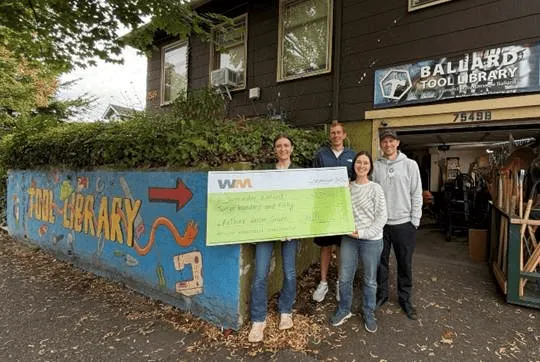
Cathy Moul lost $30,000 in tulips, irises, daffodils, and peonies in December. Her Everett flower farm sat underwater for nearly two months after the Snohomish River broke its flood record, destroying everything she and her mother Xee Yang had just planted.
Moul is 26. She left a project management job at a smart home automation company to take over the farm her mother had run for more than two decades.
Seven months into the transition, what Gov. Bob Ferguson called the costliest natural disaster in Washington state history hit her fields.
The decision she faced afterward — rebuild or walk away — is the same one confronting Hmong flower farmers across Snohomish County. And it matters directly to Pike Place Market, where Hmong farmers make up nearly 60% of farm vendors, according to the Seattle Times.
"We spent close to $30,000 worth on those flowers, and for it to be like, wiped away," Moul told the Seattle Times. "I was freaking out."
The scope of the damage
Among 36 Hmong farmers surveyed by the Hmong Association of Washington after the December 2025 floods, estimated losses ranged from $25,000 to $150,000 per farm.
FEMA approved a major-disaster declaration in April 2026 but separately denied Ferguson's request for mitigation funding to reduce future flood damage.
Down the road from Moul in Everett, Yeng Lee Cha, 67, came home from selling flowers at Pike Place Market the night the Snohomish River crested to find her fields covered in floodwater with hay bales floating on top.
One greenhouse was gone. Another was crushed. She lost about half her peonies — plants 8 to 10 years old — across one to two acres.
Cha arrived in Washington in 1979, around age 20, after fleeing Laos. None of her six children plan to take over the farm. She is considering selling part of it for the first time.
What this means for Pike Place Market
All flowers sold at Pike Place Market must be grown within 100 miles of Seattle and sourced from multigenerational family farms, according to Market PDA rules.
A KING5 report in June cited the Pike Place Market Foundation's finding that 84% of vendors were impacted by the winter floods, with losses totaling more than $250,000 across the vendor community.
Separately, the Foundation announced $372,550 across 52 grants to help farmers recover and sustain multigenerational operations, part of a $1.5 million investment the Foundation called one of the largest in its more than 40-year history.
But grant money doesn't solve the succession problem. Cha still leaves before dawn for Pike Place and returns to the farm at night to pick flowers by headlamp. Her husband has Parkinson's disease and can no longer help. Vendor Shor Chang routinely works 16-hour days, arriving at 6 a.m. for the market, then heading back to the farm, often not getting home until 10 or 11 p.m.
Moul chose to stay
Moul decided to keep the farm. She introduced new flower varieties, started a social media page that brought in new business, and renamed the operation Cathy's Garden. She now translates for other Hmong vendors at Pike Place Market.
Yang, hospitalized in April 2026 with severe anemia, has stepped back. Moul manages the farm work and takes her mother to doctor's appointments several times a week.
The Hmong farming community in Washington grew out of King County's Indochinese Farm Project in the 1980s and 1990s, which helped refugees from the Vietnam War access farmland and sell at local markets. That generation is aging out. Cha is considering selling. Moul chose to stay. The generation between them is mostly gone.