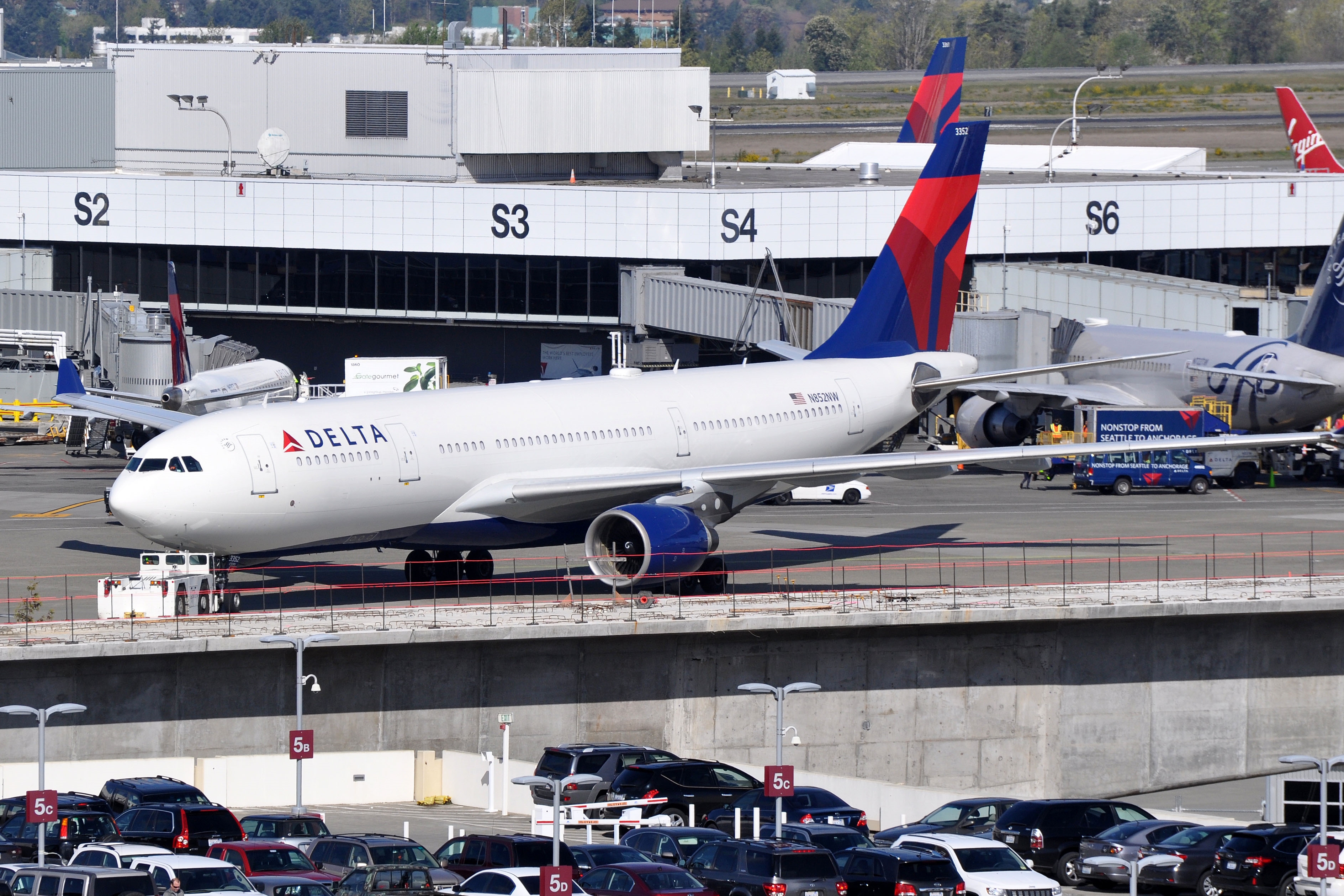
A proposed class-action lawsuit accusing Delta Air Lines of hiding pay ranges from Seattle-area job applicants landed back in federal court on July 8, with more than $5.8 million in potential damages on the line.
Brian Davis, a Snohomish County resident, alleges Delta violated Washington's Equal Pay and Opportunities Act by posting a King County job without disclosing a wage scale or salary range. Davis applied on April 24, 2024, for an in-flight service field operations support coordinator position. The posting listed benefits and perks but no pay.
Davis says that prevented him from evaluating the job, comparing it with other opportunities, and negotiating his salary.
Delta denies the allegations.
The dollar figure
Davis seeks $5,000 in statutory damages for himself and every member of the proposed class — anyone who applied for a Delta job in Washington on or after January 1, 2023, when the posting lacked a salary range.
Delta's own filing estimates the class includes at least 1,100 applicants, putting $5.5 million in statutory damages plus an estimated $362,500 in attorney fees at issue, according to KING 5's reporting on the court filings.
The lawsuit has bounced between courts. Davis filed in King County Superior Court on May 29, 2024. Delta removed the case to federal court in June 2024. A federal judge sent it back to state court in April 2026, finding Delta had not established Davis was a bona fide job applicant.
Delta's July 8 notice to the U.S. District Court for the Western District of Washington argues new discovery responses resolve that question. Davis acknowledged he applied "with the intent of obtaining employment with Delta" and denied applying for any other reason.
No hearing date has been set on the renewed removal.
What the law requires
Washington's pay transparency statute (RCW 49.58.110, known as the Equal Pay and Opportunities Act) has applied since January 1, 2023, to every employer with 15 or more employees doing business in the state. Every job posting must include a wage scale or salary range, a general description of benefits, and a description of other compensation, according to the Washington Department of Labor and Industries.
The law covers electronic and printed postings, third-party recruiting, and remote positions that could be filled by a Washington-based worker. Job applicants have four years from the date of a violation to file a complaint.
The 2025 amendment
Governor Bob Ferguson signed SB 5408 on May 20, 2025, amending the statute effective July 27, 2025. The changes introduced a five-business-day grace period for employers to fix non-compliant postings after written notice and replaced the flat $5,000 penalty with discretionary damages of $100 to $5,000 per violation.
Those changes were prompted by what attorney Charles K. Davis wrote in Washington State Bar News was a "cottage industry" of class-action litigation — hundreds of suits filed by early 2025, including cases brought by applicants who applied solely to find violations.
Because Davis filed his lawsuit in May 2024 under the original statute's flat $5,000 provision, his claims appear governed by the pre-amendment damages structure. No court has ruled on the retroactivity question.
The amended law still applies to every Washington employer with 15 or more workers posting jobs. Under the current statute, a non-compliant posting exposes an employer to $100 to $5,000 per applicant in damages, plus attorney fees.
The case is pending federal court review of the renewed removal.