Judkins Park in the Central District is where three teenagers won a rap competition in 1982 and launched Seattle's Hip Hop scene. There's no plaque telling you so.
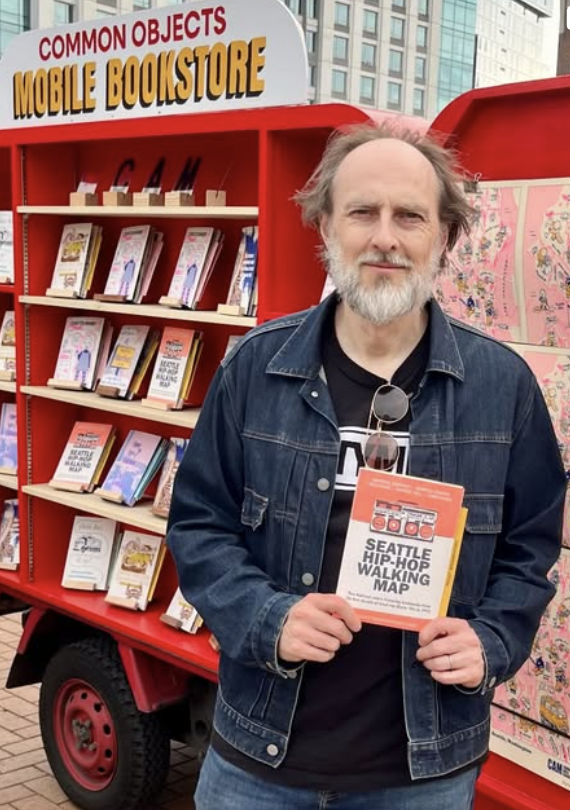
A new free zine called "The Seattle Hip-Hop Walking Map" marks that spot and 22 others across the Central District, Capitol Hill, and downtown where the city's rap culture was born between the early 1980s and 1993.
Music researcher Gary Campbell created the 7-mile, two-route guide after years of archiving lost Seattle rap records, and nonprofit Common Area Maintenance (CAM) is distributing it at pop-up events through summer 2026.
Campbell, originally from Toronto, moved to Seattle in 2013 and founded his own rap label, Crane City Music. During the pandemic he began archiving lost local rap records. He joined CAM as a space to research a book on Seattle rap, and the walking map grew out of that work.
The Central District is the historically Black neighborhood that has experienced the most dramatic displacement of any Seattle community over the past 30 years.
Many of the landmarks on Campbell's map no longer exist in their original form. The buildings changed, the community was pushed out, and the stories nearly went with them.
"I have a friend who owns a record store in Capitol Hill — I remember chatting with him, and he was like, 'Yeah, I sell 10 copies of "Nevermind" by Nirvana a day,'" Campbell told The Seattle Times on Monday, July 21. "It's one of those things like, why isn't it the same enthusiasm, love, discussion, excitement around Seattle Hip Hop?"
The first route starts at Judkins Park, where Hip Hop group Emerald Street Boys battled each other at the 1982 Black Community Festival and won a slot to perform at that year's Seafair Torchlight Parade.
The group released the first local rap record in 1983. Other Central District stops include Washington Hall, where Emerald Street Boys performed alongside Emerald Street Girls and Silver Chain Gang in 1982, and the Rotary Boys & Girls Club, where Sir Mix-A-Lot got his start playing turntables for neighborhood kids.
Four blocks east, Garfield High School appears as the alma mater of Macklemore, producer Derrick "Vitamin D" Brown, Quincy Jones, and Jimi Hendrix.
The second route runs from Seattle Center to downtown. Fisher Pavilion (formerly the Flag Pavilion) is where Emerald Street Boys became the first rap group to perform at Bumbershoot in 1983.
Dick's Drive-In on Capitol Hill shows up courtesy of Sir Mix-A-Lot's 1988 track "Posse on Broadway." The Olympic Hotel on University Street is where Nastymix Records held a black-tie gala in 1989 to celebrate "Swass," which sold 500,000 copies and became the bestselling independent album from a Northwest artist at the time.
On First Avenue, a vintage clothing store now sits where grunge club The Vogue once stood. That's where Vitamin D and Bill "B-Self" Rider, performing as Ghetto Chilldren, played with Seattle rock band IMIJ in 1993.
CAM executive director Timothy Firth said the zines are still being printed and will be available at community events through the summer.
The Pocket Neighborhoods project, which includes Campbell's map and nine other artist-made zines exploring Seattle's hidden histories, was funded by a grant from the Seattle Office of Arts and Culture. Nearly 500 copies were distributed free at the June Pioneer Square Art Walk and were all claimed.
Where to pick up the zine:
- Thursday, August 6 — Pioneer Square First Thursday Art Walk (free, self-guided neighborhood event).
- Friday, August 7, 7 p.m. — CAM Word Party at Paper Pushers, 1200 5th Ave. Free.
For additional pop-up dates, visit camseattle.org or follow @common_area on Instagram.