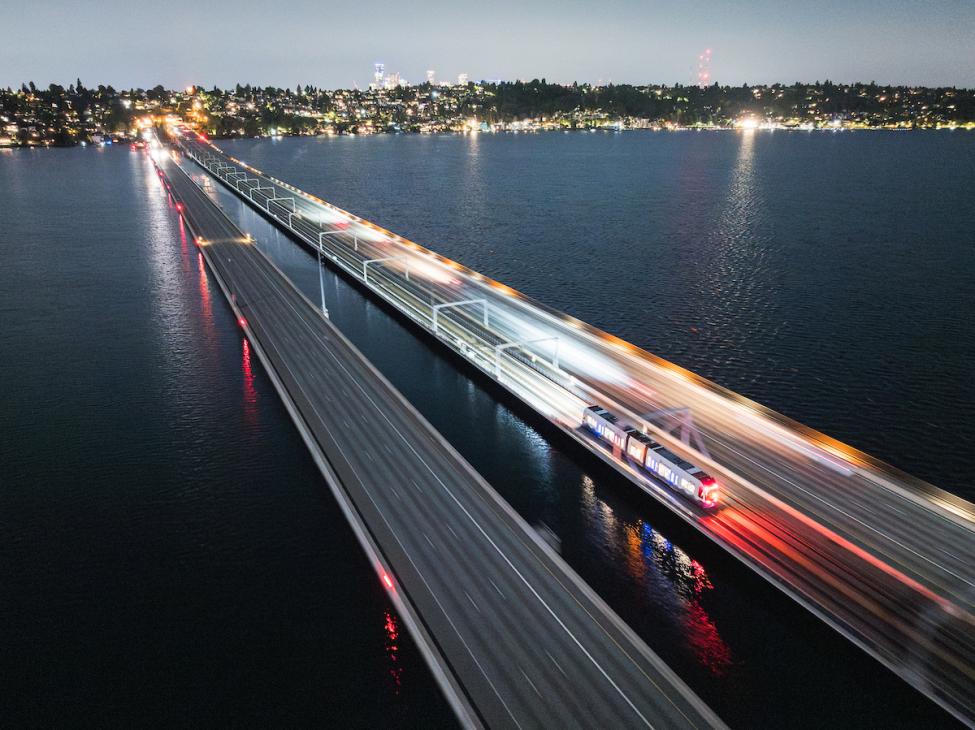
Trains weighing 600,000 pounds now cross Lake Washington at 55 mph on a bridge that bobs with every wave.
Five months after the 2 Line's Crosslake Connection opened on March 28, Sound Transit's I-90 floating bridge corridor remains the only passenger rail line on a floating structure anywhere in the world.
Systemwide light rail ridership has climbed to 175,000 daily boardings, a jump of nearly 50,000, The Seattle Times reported in a detailed look at the engineering behind the achievement.
For riders connecting between Seattle and the Eastside, the 20-minute trip from Chinatown-International District to downtown Bellevue feels unremarkable. That smoothness required solving three problems no transit agency had faced before.
Locking the pontoons together
Lake Washington is 200 feet deep with a silty bottom that cannot support bridge columns. The Homer M. Hadley Bridge floats on 18 hollow concrete pontoons held in place by 52 anchor cables fastened to the lake floor.
To keep individual pontoons from bobbing separately under a passing train, contractors strung 1 million feet of steel cable through the middle 10 pontoons and cinched them into a single rigid barge.
Workers compared the job to "building a ship in a bottle," according to the Times.
The compression, called posttensioning, squeezed the concrete so tight the bridge shrank 3 inches.
The result: on March 28, the first loaded train crossed. It pushed the bridge down just over 1 inch, confirmed by University of Washington sensors.
Tracks that flex with the lake
About 80% of rail movement on the bridge comes from lake and wave motion, not the trains themselves, according to Craig DeLalla, Sound Transit's director of asset-management engineering.
British engineer Andy Foan invented 43-foot-long platforms that carry tracks over the hinge points where fixed and floating spans meet near shore. The rails sit on seismic bearings, similar to those supporting the roofs at Lumen Field and T-Mobile Park, that flex to match bridge motion while keeping rails parallel.
Without those eight platforms, Sound Transit senior technical director John Sleavin said, trains may not have been able to cross the bridge at all.
Protecting the bridge from its own electricity
Electrified rail generates stray current that can corrode steel. The pontoons contain 287 devices that steer electricity away from structural steel. Hundreds of metal anodes dangle underwater off the bridge; the sacrificial metal corrodes instead of the anchor cables.
Sound Transit spokesperson Henry Bendon told the Times: "Think of charging 287 different iPhones to exactly 81% while the iPhones are floating."
$1 billion and six years late
The Washington State Department of Transportation required a design that would preserve the bridge for at least 70 more years. The 7-mile corridor cost $1 billion and arrived six years behind schedule. Bellevue route disputes consumed three years. A rebuild of track ties Sound Transit deemed defective added three more.
The corridor opened to cheering crowds on March 28. KUOW reported that Gov. Bob Ferguson called the connection's significance impossible to overstate. The light rail network now stretches 63 miles across 50 stations in 13 cities.
One breakdown has occurred since the March 28 opening: a train stalled for 45 minutes near Mercer Island on May 4 after a voltage spike near Federal Way. Route 550, the express bus between Seattle and Bellevue for decades, is set to retire in fall 2026 as the 2 Line takes over.