When the United States celebrates its 250th birthday next month, Seattle residents won't have to look far to find evidence of the generations who helped build the nation.
Some of it is hidden in plain sight and much of it traces back to Seattle’s Jewish community, whose history in the Pacific Northwest predates Washington statehood itself.
Jewish settlers arrived in Washington Territory as early as 1855. Over the next century, those immigrants and their descendants would help rebuild Seattle after disaster, finance its growth, and established major civic institutions across the City.
Their story mirrors a broader American one: immigrants arriving at the edge of a growing nation and helping shape the places they called home.
Among the most influential was Bailey Gatzert, a German-born merchant who arrived in Seattle in 1869. Just six years later, he became the city's eighth mayor — and remains the only Jewish mayor in Seattle's history.
Gatzert helped found Washington's first Jewish congregation, invested in Seattle's first water system and helped establish the Seattle Chamber of Commerce. His wife, Babette Schwabacher Gatzert, co-founded the Ladies Relief Society in 1884, Seattle's first and oldest charitable organization now known as Seattle Children's Home.
Together, they helped establish a tradition that would define much of Seattle's Jewish community: civic engagement as a responsibility rather than a separate pursuit.
After the Great Seattle Fire of 1889 destroyed much of downtown, banker Jacob Furth emerged as one of the key figures in the city's recovery. Furth, a Jewish immigrant from Bohemia who founded Puget Sound National Bank, pledged that his institution would not profit from the disaster and instead offered loans to support rebuilding efforts.
Just a few years later, during the Panic of 1893, Furth again found himself at the center of a crisis. With financial institutions across the region under pressure, he traveled to New York to secure capital that helped stabilize not only his own bank but others throughout the city.
His efforts earned him a reputation as one of the architects of modern Seattle. Furth would later consolidate the city's fragmented streetcar systems into Seattle Electric, helping lay the groundwork for the region's transportation network. In turn, this helped establish the Central District as the heart of Jewish life in Seattle. The neighborhood became home to synagogues, businesses and community organizations that anchored generations of families.
Some of those landmarks remain.
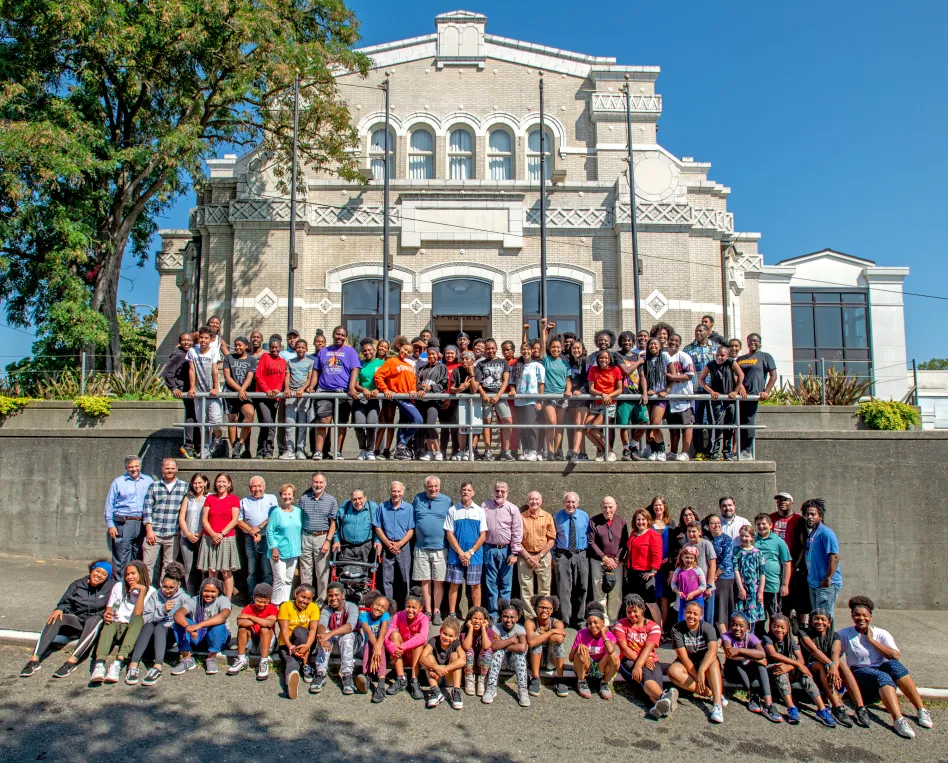
Stars of David are still visible on the former Sephardic Bikur Holim synagogue at 20th Avenue and Fir Street. The building that now houses the Langston Hughes Performing Arts Institute was originally constructed as the Bikur Cholim synagogue. Temple De Hirsch Sinai, founded by seven Jewish pioneers in 1899, grew into the Pacific Northwest's largest Reform congregation.
As Seattle and the nation prepare to commemorate America's semiquincentennial, those institutions offer a reminder that the country's story was built not only by national figures but by local communities.
The contributions of Seattle's Jewish residents were not confined to any single industry or era. They helped build businesses, charities, congregations, transportation systems and civic organizations. They rebuilt after fires, weathered economic crises and created institutions that continue to serve the city today.
A century and a half later, their imprint remains woven into Seattle's landscape — and into the broader American story the nation will celebrate on its 250th birthday.