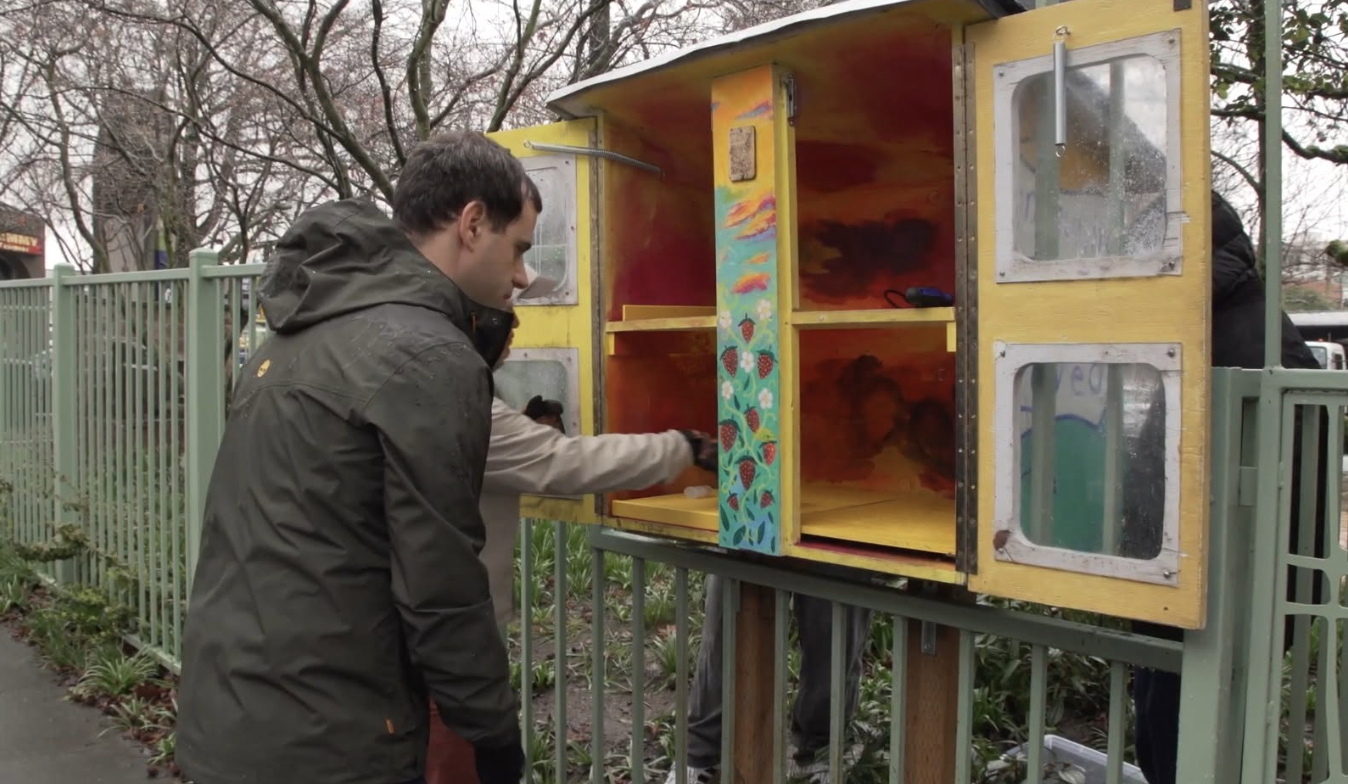
The hand-painted little free pantry outside St. Paul's Episcopal Church at 15 Roy Street gets opened about 23 times a day.
Most of those visits, somebody walks away with food. Now a University of Washington scientist wants to make sure there's always something on the shelf when they do.
Giacomo Dalla Chiara, a senior research scientist at UW's Urban Freight Lab, has outfitted the St. Paul's pantry and three others across Seattle with door sensors and digital scales that track, in real time, when food is taken and when it's restocked.
The data feeds to pantrymap.org, a free app where neighbors can check stock levels before walking over.
The project, funded by a $700,000 National Science Foundation grant, is what Dalla Chiara's team calls the first connected network of community food micropantries in the country, according to the UW Urban Freight Lab's announcement. His team estimates Seattle has roughly 300 micropantries that collectively move 4 million pounds of food a year, all without set hours, intake forms, or ID checks.
"It puts numbers on what we're actually accomplishing," said Stephen Crippen, rector at St. Paul's. "It helps us get in touch with what's going on on this street."
Barbara Potgieter, the church's treasurer, restocks the pantry by hand every day at a cost of about $800 a month. The sensor system, which costs roughly $150 per pantry to install, could eventually alert volunteers when shelves run low rather than requiring someone to physically check.
Vicente Arroyos, a doctoral student in UW's Paul G. Allen School of Computer Science & Engineering, built the sensor suite. The team deliberately avoided cameras. The sensors measure only weight changes and door openings, preserving the anonymity of anyone who uses the pantry.
Four more pantries will receive sensors soon, bringing the total to eight. Dalla Chiara plans to release the code and schematics for free so any neighborhood group can wire up its own box. The full project launches this summer and wraps up in October 2026.
The broader food picture adds urgency. Eleven percent of Washington households experienced food insecurity in 2024, according to USDA figures cited in the Seattle Times. Ballard Food Bank Executive Director Jen Muzia told KNKX in July 2025 that demand has surged since the pandemic, underscoring why tracking pantry stock levels matters across the city.
Cascade Bicycle Club's Pedaling Relief Project, managed by Landon Coates Welsh, will use cargo bikes to distribute 10,000 pounds of food from a Ridwell drive to micropantries citywide this summer.
Emerald City Wire could not confirm which specific Ballard or Magnolia micropantries, if any, are among the sensor-equipped sites. Readers can find their nearest pantry at pantrymap.org.
How to help: Stock your neighborhood micropantry with nonperishable food. Find the closest one at pantrymap.org. St. Paul's pantry at 15 Roy Street accepts donations anytime.
What happens next: The sensor-equipped network goes fully live this summer, with Dalla Chiara's team collecting data through October 2026. The code and hardware schematics will be published for free, meaning any Queen Anne block club, Ballard church, or Magnolia neighbor with a micropantry can replicate the setup for about $150.